Updated September 2026 | Plumbing | By PowerRoute Electric & Plumbing
A conventional storage tank water heater has a published life expectancy of 6 to 12 years. ENERGY STAR puts a gas tankless unit at 20 years. A heat pump water heater uses the same glass-lined steel tank as an electric model, so plan on tank numbers, with a compressor and fan as extra failure points.
InterNACHI’s home inspection life expectancy chart puts a conventional water heater at 6 to 12 years, which is where that number comes from. It is a national figure. InterNACHI also notes that the mineral content of water can shorten the life expectancy of water heaters, and Pasadena and the San Gabriel Valley run very hard water. The measurements are further down this page. We install and replace these tanks across Pasadena, Glendale, Burbank, and the San Gabriel Valley.
National averages will not tell you whether to wait or act. Your unit’s age will. Here is how to find it, what the warning signs mean in order, and where the repair-or-replace line sits.
How Long Each Type of Water Heater Lasts
Three numbers matter: the published national life expectancy, what we see locally, and the failure mode you will hit first.
| Type | Published life expectancy | What hard water does to it | What ends it |
|---|---|---|---|
| Gas or electric storage tank | 6 to 12 years (InterNACHI) | Shortens it. Scale insulates the burner and stresses the tank bottom. | Tank corrosion after the anode rod is consumed, accelerated by scale |
| Tankless (gas or electric) | 20 years for gas tankless (ENERGY STAR). InterNACHI lists instant, on-demand units at 10 years. | Scale narrows the heat exchanger passages, which is why manufacturers call for descaling in hard water | Scale in the heat exchanger |
| Heat pump (hybrid) tank | Tank warranty typically 10 years | Same tank effects as above, plus a compressor and fan as added failure points | Same tank corrosion as a standard tank, plus compressor and fan failure |
ENERGY STAR, on its gas tankless page, states it plainly: “Tankless water heaters have a life expectancy of 20 years, much longer than any conventional tank-type water heater.” That figure is published for gas tankless units. InterNACHI’s chart lists an instant, on-demand water heater at 10 years. Neither source explains the gap between the two numbers, so treat 10 to 20 years as the honest range and read the maintenance section before assuming the top of it.
One shortcut on tanks: read the warranty. A 6-year and a 12-year model from the same brand often share a shell. The difference is anode mass and tank lining. Manufacturers price the warranty to the parts most likely to fail, so warranty length is a reasonable proxy for build quality.
How to Find Your Water Heater's Manufacture Date in 60 Seconds
Almost nobody knows the age of their water heater. Almost everybody has the answer printed on the side of it.
Step 1: Find the rating plate
Look for a sticker or metal plate on the front or side of the tank, usually near the top. On a tankless unit it sits on the lower right of the cabinet. Photograph it. The model number and serial number are both on it.
Step 2: Look for a printed date first
Many plates print the manufacture date outright, labeled as “Mfg Date,” “Date Code,” or a plain month and year. Check before decoding anything.
Step 3: Decode the serial number
No date on the plate means the serial number holds it. The format depends on the brand.
| Brand | Serial format | Example | Reads as |
|---|---|---|---|
| A.O. Smith, State, American, Reliance, Whirlpool, Kenmore | Year (2 digits) then week (2 digits) | 1220 followed by digits | Week 20 of 2012, roughly mid-May |
| Rheem, Ruud, Richmond, GE | Month (2 digits) then year (2 digits) | 0720 followed by digits | July 2020 |
| Bradford White | Year letter then month letter | WC followed by digits | March 2020 |
| Rinnai (late 2009 and newer) | Year letter then month letter. Units built before late 2009 use four digits, year then month | EA followed by digits | Year letter E is 2013, month letter A is January |
| Noritz | Four digits for the year, then two for the month, sometimes printed with a period | 201806, printed on many plates as 2018.06 | June 2018 |
These formats change between production runs, and the charts published by home inspectors do not always agree. If the decode does not match the age the unit appears to be, call the brand technical support line with the full serial number and ask them to confirm the build date.
Watch the overlap. A serial starting 1219 on a Rheem reads as December 2019. The same 1219 on an A.O. Smith reads as week 19 of 2012. Seven years apart. Identify the brand before you read the digits.
Bradford White year letters repeat on a 20-year cycle, so W is either 2000 or 2020. If the unit looks new and the house sold recently, take the later year. If the plate is sun-faded and the fittings are galvanized, take the earlier one.
Month letters on Bradford White and Rinnai run A through M and skip the letter I. A is January, B is February, C is March, and M is December.
What to do with the number
Write the install year on the tank in marker, along with the date of your last flush. Every plumber who works on it after you will be glad, and so will the next owner.
Why Water Heaters Die Faster in the San Gabriel Valley
Pasadena Water and Power reports an average hardness of 12.9 grains per gallon and describes the supply as “very hard.” Hardness shifts through the year as the city rotates its sources.
Convert 12.9 grains per gallon and you get roughly 221 mg/L. The USGS classifies anything above 180 mg/L as very hard. Pasadena clears the threshold by a wide margin, and neighboring San Gabriel Valley communities test in the same range.
The USGS explains what heating hard water does: solid calcium carbonate deposits form, and the resulting scale “can reduce the life of equipment, raise the costs of heating the water, lower the efficiency of electric water heaters, and clog pipes.”
InterNACHI’s inspection guidance puts it in one line: “The mineral content of water can shorten the life expectancy of water heaters and clog showerheads.”
What scale does inside a tank
Minerals drop out of suspension when water heats, then settle on the bottom of the tank. On a gas unit the burner sits directly under a growing insulating layer. The burner fires longer to reach setpoint, and the steel above it runs hotter than designed. Heat stress cracks the glass lining. Once bare steel meets water, corrosion starts.
On an electric unit the sediment buries the lower element, which then burns out early.
The rumbling you hear from an older tank is water flashing to steam under the sediment layer. It is a direct symptom of the process above.
What scale does inside a tankless unit
A tankless heat exchanger runs narrow passages at high heat. Scale narrows them further, flow drops, exit temperature climbs, and the unit throws an error or fails outright. A.O. Smith notes the mechanism for tanks and it applies to both: “If you live in a hard water area, you may need to flush your water heater more often.”
Softening the whole house helps every appliance downstream. It is also a larger project than most people expect. Treat it as a separate decision from the water heater itself.
The Anode Rod Decides How Long Your Tank Lasts
Every glass-lined steel tank ships with a sacrificial anode rod, usually magnesium or aluminum. It corrodes so the tank does not. That is the entire design.
The rod is consumable. When it is gone, the water goes to work on the next most reactive metal in the tank, which is the steel shell wherever the glass lining has a flaw. From there the countdown is short.
A.O. Smith recommends inspecting the rod once a year, and replacing it when it “shows signs of deterioration or has several inches of exposed core wire.” In water this hard, keep to that annual schedule rather than waiting for a symptom.
Two honest caveats. A rod seized in place after a decade will not come out without risking the tank fitting, and a fresh anode in an 11-year-old tank does not undo the corrosion already there. Anode replacement pays off on a young tank with plenty of published life left. On a tank already near the top of its 6 to 12 year range, put the money toward the replacement instead.
Softened water consumes magnesium anodes faster, not slower. Homes with a softener should check more often, or switch to an aluminum-zinc rod.
Warning Signs, in the Order They Show Up
These arrive in a rough sequence. Earlier signs usually leave room to plan. Later ones do not. How much time any one of them buys depends on the tank, the water, and where the corrosion started, so treat the order as the useful part rather than a countdown.
1. Rusty or metallic hot water
Run only the hot side into a white container. Brown or rust-tinted water on the hot side, with clean water on the cold, points to the tank interior. Galvanized supply piping produces the same look, so rule that out first. On an older tank, this means the lining has failed, and a failed lining does not heal. Schedule the replacement rather than waiting for a leak.
2. Rumbling, popping, or crackling during a heating cycle
Sediment. The unit still works. It works less efficiently every month, and the tank bottom is taking heat stress it was not designed for. Not urgent by itself. It is the signal to start flushing, or to replace on schedule if the tank is already near the top of its published range.
3. Hot water running out earlier than it used to
Sediment occupies volume that used to hold water. A 50-gallon tank with four inches of sediment holds closer to 40. On an electric unit, a failed lower element produces the same complaint.
4. Pilot outages, ignition faults, or error codes
Often a repair rather than a replacement. A thermocouple, gas valve, or igniter is a real fix on a young unit. On a tank past ten years, the same repair is money spent on a tank near the end anyway.
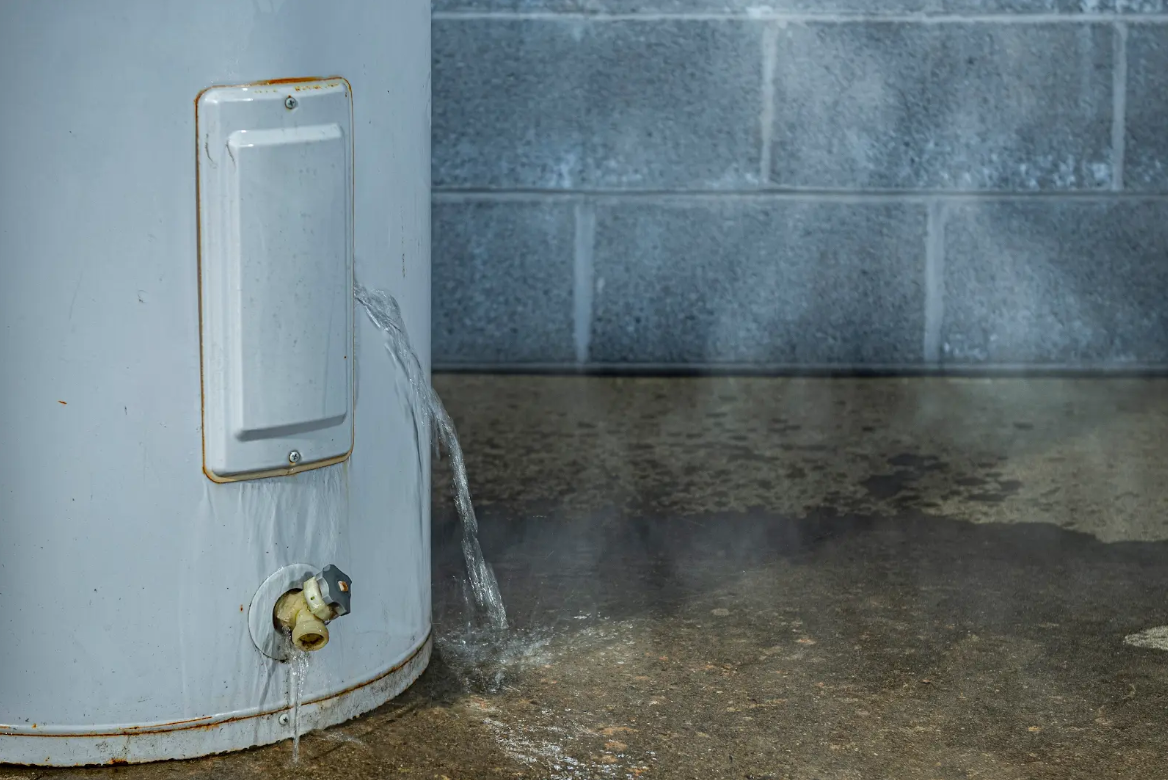
5. Moisture, rust streaks, or a damp ring at the base
Check the T and P relief line and the fittings first, because those are repairable. Seepage from the tank seam is not. A weeping tank is the last stage before a rupture. Do not wait on it.
6. Standing water
Close the cold water inlet valve above the heater. Shut the gas at the unit, or the breaker on an electric model. Then call. This is not a wait-and-see stage.
For a full diagnostic walkthrough of these symptoms, read our guide on when to repair or replace your water heater in Pasadena.
Repair or Replace, by Age
Age carries more weight than the specific fault. A cheap part in an old tank is still an old tank.
| Age of tank | Default call | Why |
|---|---|---|
| Under 6 years | Repair | Inside warranty on most units. Parts are available and the tank has life left. |
| 6 to 10 years | Depends on the repair | Repair if the cost stays under roughly a third of replacement. Replace if it goes higher. |
| Over 10 years | Replace | Any significant repair buys a short extension on a tank already at the end of its published life. |
| Any age, tank leaking | Replace | A leaking tank is not repairable. |
Two adjustments for local conditions. Hard water shortens tank life, so treat these bands as the optimistic version. And a tank in a finished interior space or an attic deserves a more conservative call than one sitting on a garage slab, for reasons in the next section.
When replacement is the answer, our water heater installation service covers gas, electric, and heat pump tanks across Pasadena and Los Angeles. For repairs, see water heater repair and replacement in Pasadena.
What a Failure Costs in a Finished Space
Tank failures run a range. Some start as a slow seep at a fitting or a seam, which gives you a chance to catch it. Others open at once and dump the tank, 40 to 50 gallons on a typical residential unit. In the fast version the cold supply keeps feeding the opening until somebody closes the inlet valve, so a rupture at 2 a.m. runs for hours.
The Insurance Information Institute puts the average homeowners claim for water damage and freezing at $13,954 across 2018 to 2022. That figure spans every cause of water damage, not water heaters alone, and a garage-slab failure costs a fraction of it. A tank in a hallway closet above hardwood is the version of the event insurers are averaging.
Location changes the math more than any other variable:
- Garage slab with a floor drain nearby. Best case. Water goes out the door.
- Interior closet. Drywall, baseboards, flooring, and whatever shares the wall.
- Attic or upper floor platform. Worst case. Water travels down through ceilings.
A drain pan handles a slow drip. It does not handle a rupture, and many pans in older LA homes drain to nothing. Three cheap protections are worth more than the pan: know where your cold inlet valve is, put a $20 leak sensor at the base, and replace on schedule rather than on failure.
Is Flushing Actually Worth It?
For a tank in San Gabriel Valley water, yes. A.O. Smith calls for flushing “at least once per year” and more often in hard water areas.
One caveat nobody mentions: flushing a tank for the first time at year eight carries risk. Sediment shifts, the plastic drain valve fails to reseat, and you have a slow leak where you had none. Start flushing in year one and keep the schedule. If a tank has never been flushed and is already past eight years, budget for replacement instead of a first flush.
Tankless units are different. Annual descaling with a pump and a vinegar or descaler solution is not optional in this water, and skipping it voids some manufacturer warranties. Our page on tankless water heater installation covers service intervals, and tankless water heater cost in Los Angeles covers what descaling runs locally.
The 15-minute annual check
- Test the temperature and pressure relief valve by lifting the lever. Water should discharge and stop.
- Look at the base and the fittings for rust or moisture.
- Flush until the water runs clear.
- Inspect the anode rod once a year.
- Confirm both seismic straps are tight.
California Rules That Apply When You Replace
California Health and Safety Code section 19211 requires “all new and replacement water heaters, and all existing residential water heaters” to be “braced, anchored, or strapped to resist falling or horizontal displacement.” Sellers must certify compliance in writing to the buyer. If you are listing a house, this one gets checked.
Replacement also brings the install up to current code, and the items people get wrong are conditional rather than automatic. Venting has to meet current requirements for the unit you install. Thermal expansion control, usually an expansion tank, is required under CPC 608.3 when the house is a closed system, meaning a pressure regulator, check valve, backflow preventer, or a non-bypass meter keeps pressure from relieving back to the main. A drain pan is required under CPC 507.5 where the heater sits somewhere that leakage would cause damage, not in every location. Jurisdictions adopt their own code cycle, so confirm the current sections when you pull the permit. Our water heater installation page lists the code items in detail, and the water heater buying guide covers sizing and fuel type.
A note on rebates
Statewide heat pump water heater rebates through TECH Clean California were fully reserved for single-family projects as of February 2026, with Central and Southern California reserved since January 2026. Utility-level programs run separately and change through the year. Check the Switch Is On incentive finder and your own utility before assuming an amount. Do not let a contractor quote subtract a rebate without naming the program.
Find Out Where Your Water Heater Stands
Photograph the rating plate, decode the date, and compare it against the bands above. A tank at year nine with clean hot water and no noise has time. A tank at year nine with rust in the hot line does not.
If the number surprised you, we will look at it. PowerRoute handles water heater installation and replacement across Pasadena, Glendale, Burbank, Arcadia, and Los Angeles, and we will tell you when a unit still has years left.
Frequently Asked Questions
InterNACHI’s home inspection life expectancy chart puts conventional water heaters at 6 to 12 years. ENERGY STAR puts gas tankless units at 20 years, and InterNACHI lists instant, on-demand units at 10 years. Hard water shortens all of these figures. A heat pump water heater uses the same steel tank as an electric model, so expect tank-level life with a compressor as an extra failure point.
Photograph the rating plate on the side of the tank. Many plates print the manufacture date directly. If yours does not, decode the serial number. A.O. Smith, State, American, and Whirlpool use year then week, so 1220 is week 20 of 2012. Rheem, Ruud, and Richmond use month then year, so 0720 is July 2020. Bradford White uses a year letter followed by a month letter.
Yes. The USGS states that scale from heated hard water reduces the life of equipment, raises heating costs, and lowers the efficiency of electric water heaters. Pasadena Water and Power reports an average hardness of 12.9 grains per gallon and describes the supply as very hard, which is well above the USGS very hard threshold of 180 mg/L.
Replacing a tank at year 10 to 12 on your schedule costs less than replacing it after a rupture. The Insurance Information Institute puts the average homeowners water damage and freezing claim at $13,954 across 2018 to 2022. Units in interior closets, on upper floors, or in attics carry the most risk from a failure.
ENERGY STAR puts the life expectancy of a gas tankless water heater at 20 years. InterNACHI lists instant, on-demand water heaters at 10 years. Neither source explains the gap. Manufacturers call for descaling on a schedule, and in water this hard that is the maintenance item that matters most.
Flushing removes the sediment layer that insulates the burner and stresses the tank bottom. A.O. Smith recommends flushing at least once per year, and more often in hard water areas. Start in the first year. Flushing a neglected tank for the first time after eight years risks dislodging sediment and causing a drain valve leak.
Sources
- InterNACHI, Standard Estimated Life Expectancy Chart for Homes
- ENERGY STAR, Gas Tankless Water Heaters, Benefits and Savings
- Pasadena Water and Power, Water Quality FAQs
- U.S. Geological Survey, Hardness of Water
- A.O. Smith, Water Heater Maintenance Guide
- Insurance Information Institute, Facts and Statistics, Homeowners and Renters Insurance
- California Health and Safety Code, Section 19211
- TECH Clean California, Single Family Incentives
- California Plumbing Code, Sections 507.5 (drainage pans) and 608.3 (thermal expansion control)